

With firmware versions 1.11 and 1.12, Heliotis is consistently advancing the Gen4 platform for heliInspect and heliCam. In addition to numerous detailed improvements, users benefit in particular from higher measurement accuracy of the heliInspect white light interferometers, a larger vertical measurement range, new integration options, and additional functions for the heliCam Lock-in cameras.
As usual, all improvements are available to existing customers via a firmware update – no hardware replacement is required.
Higher Measurement Accuracy through Optimized Data Acquisition and Surface Reconstruction
The measurement accuracy of a white light interferometer is not determined by optics and mechanics alone. Equally decisive is how the interference signals are captured during the scan and subsequently evaluated. With firmware 1.11, two fundamental improvements were therefore introduced that address precisely these points.
Encoder-Based Referencing
In previous firmware versions, the measurement frames recorded during a scan were already linked to the current encoder position of the scan axis. This allowed deviations from a constant scanning speed to be largely compensated for during reconstruction.
With the new Encoder-Based Reference Mode, data acquisition is taken a step further. Measurement frames are no longer recorded at a fixed frame rate and then assigned to an encoder position. Instead, the scan axis triggers each recording directly at a defined encoder position. As a result, the measurement frames are created during acquisition at equidistant intervals of λ/8.
In addition to further improved position assignment, the signal processing in the heliSens image sensor also benefits from this, as the Lock-in demodulation takes place under ideal sampling conditions. Together with the new CenterOfMassPhaseFusion, the Encoder-Based Reference Mode forms the basis for the significant improvement in repeatability shown in the next section.
CenterOfMassPhaseFusion as an Integrated Extraction Mode
With firmware 1.11, surface reconstruction was expanded to include the new CenterOfMassPhaseFusion extraction mode. The algorithm combines the robust and unambiguous position information of the coherence envelope with the significantly more precise phase information. It thus combines the advantages of both evaluation methods: a large unambiguous measurement range with simultaneously maximum measurement precision.
While this algorithm previously had to be called as a separate processing step from the heliAlgo library, it is now integrated directly into the standard evaluation of the Gen4 platform and is available as a native extraction mode via the API. Applications thus benefit from the improved reconstruction without additional implementation effort – regardless of whether they access the camera via GenICam, HALCON, MATLAB, Python, or other software environments.
Together with encoder-based referencing, CenterOfMassPhaseFusion enables the significant improvement in repeatability shown in the following section.
Improved Repeatability
The combination of encoder-based referencing and the new CenterOfMassPhaseFusion reconstruction mode significantly improves repeatability, especially for high-precision step height measurements. While the previous improvements already contribute individually to higher measurement quality, their combination achieves the best results.
The following comparative measurement shows the standard deviation of repeated step height measurements for various data acquisition and reconstruction methods. Depending on the measurement task and configuration, repeatability can be significantly increased compared to the previous standard evaluation.
The values provided refer to the repeatability of individual image sensor pixels relative to a reference plane. In contrast to many published data sheets, no averaging is performed over larger areas or several hundred pixels, meaning the measurement results conservatively reflect the actual performance of the system. The measurements were carried out on a heliInspect H8 Ultra without active vibration damping.
| Step Height [µm] | Target ± nm | Time-Based Referenz | Encoder-Based Referenz | ||||||
|---|---|---|---|---|---|---|---|---|---|
| Improved Center of Mass | Center of Mass Phase Fusion | Improved Center of Mass | Center of Mass Phase Fusion | ||||||
| σ [nm] | Hight [µm] | σ [nm] | Hight [µm] | σ [nm] | Height [µm] | σ [nm] | Höhe [µm] | ||
| 1.002 | 24 | 20 | 1.002 | 5 | 1.003 | 16 | 1.001 | 1 | 1.002 |
| 5.009 | 22 | 20 | 4.991 | 7 | 4.996 | 16 | 4.998 | 2 | 4.999 |
| 20.000 | 26 | 20 | 19.984 | 7 | 19.994 | 16 | 20.000 | 2.5 | 19.997 |
| 900.54 | 40 | 20 | 900.55 | 7 | 900.58 | 16 | 900.57 | 3.3 | 900.56 |
Larger Vertical Measurement Range through More Efficient Memory Usage
The heliInspect systems do not use a conventional 2D image sensor, but rather the heliSens Lock-in image sensor developed by Heliotis. The Lock-in demodulation takes place directly in the pixel. As a result, it is not necessary to transfer and evaluate all raw images. Instead, demodulated measurement data is generated directly on the sensor, which means that white light measurements can typically be performed up to 100 times faster than with conventional image sensors.
Each pixel integrates the interference signal over several modulation cycles and stores the two demodulated signal components – the in-phase (I) and quadrature (Q) components. These two values together form a measurement frame. During a vertical scan, a complete stack of measurement frames is created, containing the full information of the recorded interferogram.
For surface reconstruction, this measurement frame stack must be fully buffered on the camera. Only after the scan is completed does the camera determine the position of the interference maximum for each pixel from the measurement frames and calculate the surface height from it. The available memory capacity therefore directly determines the maximum number of measurement frames and thus the vertical measurement range of the system.
With firmware 1.12, the memory management of the Gen4 platform has been fundamentally redesigned. Through more efficient use of the available memory, the camera can now – depending on the sensor type – process up to three times more measurement frames per recording. The maximum usable vertical measurement range increases accordingly, without requiring any changes to the hardware.
Depending on the lens, height ranges of over one centimeter can be captured in a single continuous scan. For even larger measurement objects, the Segmented Volume function is also available, which automatically merges several vertical sub-volumes into a common 3D data set.
| Sensor Configuration | Maximum Number of Frames (Previous) | Maximum Number of Frames (Firmware 1.12.0) |
|---|---|---|
| heliSens S4H Single Memory | 1348 | 2700 |
| heliSens S4H Dual Memory | 1348 | 4048 |
| heliSens S4M Single Memory | 338 | 674 |
| heliSens S4M Dual Memory | 338 | 1022 |
Browser-Based Commissioning and Diagnostics
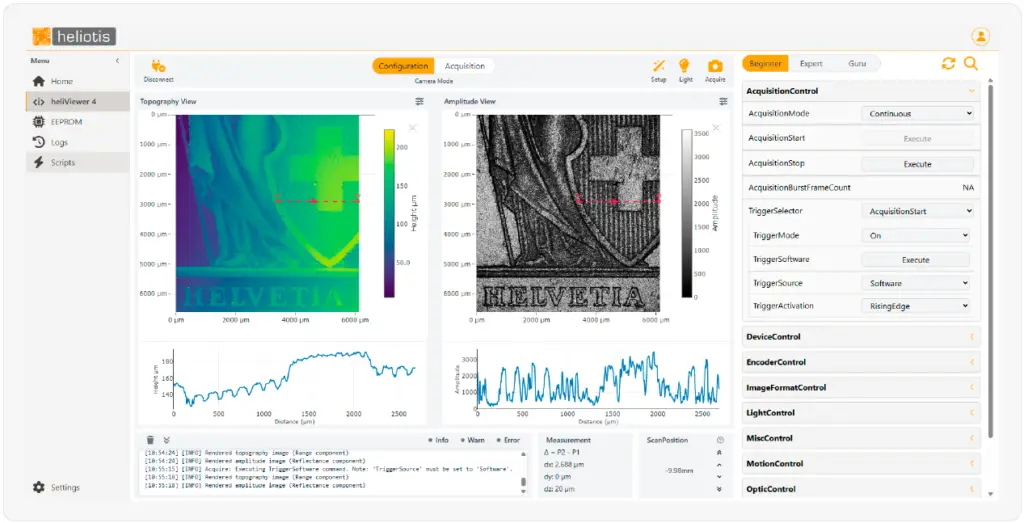
With firmware 1.12, heliViewer 4 is the first browser-based user interface to be available. Access is direct via a web browser – no additional software installation on the host PC is required.
heliViewer 4 enables the visualization of topographies, amplitude images, and live data, as well as direct access to all camera parameters. The range of functions is supplemented by integrated diagnostic functions and a setup wizard that guides the user step-by-step through the initial commissioning.
Browser-based access complements the existing GenICam, SDK, and API interfaces. This means that practically any PC or laptop can be used as a service or engineering station, which simplifies commissioning, maintenance, and diagnostics directly at the machine in particular.
heliViewer4 embedded – Quick Start
Seamless Integration into Industrial Image Processing Systems – Now also for Cognex VisionPro
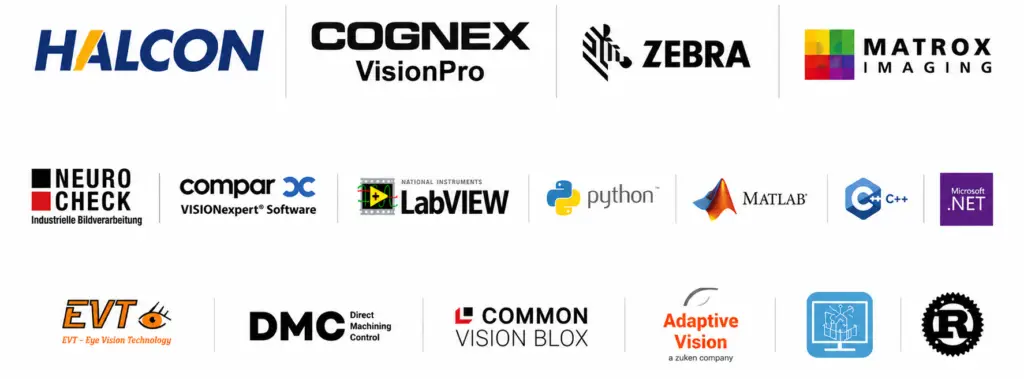
Integration into existing machine vision environments has been a central development goal of the Heliotis Gen4 platform for many years. All camera functions are available in compliance with standards via GenICam and can therefore be integrated into most industrial image processing libraries without additional development effort.
As a voting member of the GenICam consortium, Heliotis actively participates in the further development of the industry standard. Together with various software manufacturers, numerous GenICam implementations have been further developed and completed in compliance with standards in recent years. Today, practically all common GenICam-compatible machine vision platforms support the integration of heliInspect systems.
With firmware 1.12, this software ecosystem is expanded to include support for Cognex VisionPro. Since the GenICam interface of VisionPro does not currently fully support the functions required for heliInspect, the integration was carried out via the Cognex “Application Integration Kit”. This means that heliInspect is now also natively available to users of Cognex VisionPro without additional middleware.
New Functions for the heliCam Lock-in Cameras
It is not only the heliInspect white light interferometers that benefit from firmware versions 1.11 and 1.12. The heliCam C4 and C4M have also been expanded with new functions that accelerate measurement processes, simplify the synchronization of complex experiments, and facilitate commissioning.
On-Camera I/Q Accumulation
Many Lock-in applications are based on averaging a large number of I/Q measurements. With firmware 1.11, this accumulation can now take place directly on the camera. Instead of transferring all individual I/Q frames to the host PC, only one accumulated I image and one accumulated Q image are transferred.
Depending on the application, this significantly reduces the data volume to be transferred, which can significantly shorten the total measurement time. At the same time, significantly more individual measurements can be combined into one recording.
New Trigger Options for Complex Measurement Setups
A new trigger mode makes it possible to start each individual I/Q measurement frame of a sequence via an external trigger signal. This makes it much easier to synchronize the heliCam with external experiments.
A typical example is synchronization with a high-frequency square-wave signal. In conjunction with quarter-period triggering, the phase relationship between the individual measurements remains precisely defined and reproducible.
Low-Level Intensity Mode
With firmware 1.12, a low-level intensity mode is also available. This provides a live intensity image similar to a conventional camera and facilitates the commissioning of optical setups in particular.
The mode is suitable, for example, for focusing, aligning optical components, or positioning a sample. In addition, example programs for Python and MATLAB are available, which facilitate the entry into camera control and integration into own measurement software.
Conclusion
Firmware versions 1.11 and 1.12 expand the Heliotis Gen4 platform with numerous new functions and performance improvements. From higher measurement accuracy and a larger vertical measurement range to browser-based commissioning and seamless software integration, as well as new functions for the heliCam, existing systems benefit – without any changes to the hardware.
At Heliotis, product development does not end with the delivery of a system. New firmware versions continuously expand the platform with additional functions and performance improvements, ensuring that existing installations also benefit from technological progress in the long term.
For our customers, this means high investment protection: a significant part of innovation today is created through firmware and software updates rather than through hardware replacement. This extends the technological life cycle of the Gen4 platform and existing systems continuously gain in performance.
 Heliotis AG