
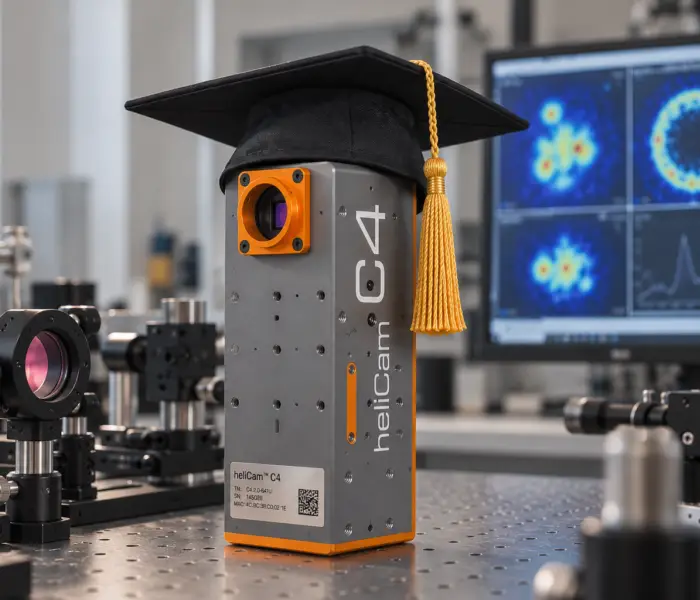
Scientific publications demonstrate where new technologies are being applied. Doctoral theses often go one step further: over several years, new measurement setups, methods, and experiments are developed – and the instruments used become an integral part of the research work.
We are therefore all the more pleased that in 2026, three dissertations were published in which the heliCam™ is used for imaging magnetic field measurement. Two projects at the University of Maryland deal with Quantum Diamond Microscopy based on nitrogen-vacancy centers (NV centers) in diamond. A third thesis at the Fraunhofer Institute for Physical Measurement Techniques IPM investigates imaging zero-field magnetometry with thin rubidium vapor cells.
The physical approaches are very different. However, they share a common challenge: small, time-modulated optical signals must be spatially resolved and captured with high sensitivity. Here, the pixel-parallel Lock-in detection of the heliCam™ offers unique possibilities.
Zechuan Yin: Quantum Diamond Microscopy with pulsed measurement methods
In his dissertation “Advanced Quantum Magnetic Microscopy With Solid-State Spin Ensemble in Diamond”, Zechuan Yin is developing a next-generation Quantum Diamond Microscope (QDM) at the University of Maryland.
NV centers in diamond can be used as highly sensitive magnetic field sensors and read out optically. In a Quantum Diamond Microscope, ensembles of such NV centers are used to capture magnetic fields not just at a single point, but across an entire field of view.
A focus of the work is the extension of this principle to advanced pulsed quantum sensing methods. To this end, the developed QDM platform combines a fast Lock-in camera with an Arbitrary Waveform Generator (AWG).
The platform enables, among other things, static and wideband magnetic field imaging with Ramsey sequences, narrowband measurements with dynamical decoupling protocols, and NMR imaging using Coherently Averaged Synchronized Readout (CASR).
The fast Lock-in detection enables the parallel evaluation of the modulated fluorescence signals across the entire field of view, thus helping to transfer established pulsed quantum sensing methods to imaging measurement.
Jiashen Tang: Dynamic magnetic fields with high temporal resolution
The dissertation “Advancing Quantum Diamond Sensing for Dynamic Magnetic Imaging and Directional Rare-Event Detection” by Jiashen Tang was also written at the University of Maryland.
In the first part of his work, Tang develops a pulsed Quantum Diamond Microscope for the imaging measurement of static and dynamic magnetic fields. The system combines double-quantum Ramsey magnetometry, spin-bath driving, and fast Lock-in detection.
The work thus demonstrates magnetic field imaging with a temporal resolution of less than one millisecond while simultaneously achieving micrometer-scale spatial resolution. Through stable averaging, magnetic fields can be resolved down to the picotesla range.
Such properties are particularly interesting for weak and time-varying magnetic fields, for example from electronic circuits, novel materials, or biological systems.
Another part of the dissertation investigates NV centers as sensors for rare events and their directional information. This research area follows a different measurement concept and simultaneously demonstrates the wide range of today’s quantum sensing with diamond.
Ronja Rasser: More than 7,000 measurement points in a thin rubidium vapor cell
Ronja Rasser pursues a different physical approach in her dissertation “Imaging Zero-Field Magnetometry with Thin Rubidium Vapor Cells” at the Fraunhofer Institute for Physical Measurement Techniques IPM.
Here, instead of NV centers in diamond, optically pumped rubidium atoms serve as magnetic field sensors. A rubidium vapor cell only 300 µm thin is read out optically over a large area. The local magnetic field influences the optical properties of the spin-polarized atoms; the resulting modulation of the transmitted light is detected with spatial resolution using the heliCam™.
With a single vapor cell, the system realizes more than 7,000 individual measurement points within a circular area of approximately 4 mm in diameter. The achieved spatial resolution is approximately 40 µm.
The measurement of a magnetic field gradient oscillating at 130 Hz demonstrates that this can be used to capture more than just static fields. A single vapor cell thus becomes a two-dimensional magnetic field camera.
We have already reported on the resulting Optics Express paper in our post “Three new research papers with the heliCam™ – From magnetic fields to millimeter waves”. The now-published dissertation places this work in the larger context of the development of imaging zero-field magnetometers.
Three dissertations – two sensor concepts – one common measurement principle
NV centers in diamond and rubidium atoms in a vapor cell are based on very different physical principles. What both approaches have in common is that the camera does not measure the magnetic field directly.
Instead, the interaction of the magnetic field with a quantum mechanical sensor system is read out optically. The desired information is contained in small changes of a modulated light signal.
This is exactly where the heliCam™ comes in: it performs Lock-in detection in parallel across many pixels, thus combining high sensitivity with imaging measurement.
We are particularly pleased that the heliCam™ was used in 2026 in three dissertations as a tool for the development of new magnetic measurement methods. The works also show how Lock-in imaging can be combined with different quantum sensors – from NV diamond to atomic vapor cells.
We congratulate Zechuan Yin, Jiashen Tang, and Ronja Rasser on the successful completion of their dissertations.
You can find these and many other scientific works featuring the heliCam™ in our collection Publications on the Lock-in camera.
 Heliotis AG