1 Million
Lock-ins.
Simultaneously.

Lock-in experiments – conceived for massive parallelism

From Point Measurement to Lock-in Imaging

Classical lock-in amplifiers perform point measurements. With lock-in imaging, however, the same demodulation is performed pixel-parallel – amplitude and phase for each pixel. This enables experiments that are difficult or impossible to achieve with point measurements: spatially resolved phase information, rapid mapping, and robust evaluations even in strong noise.

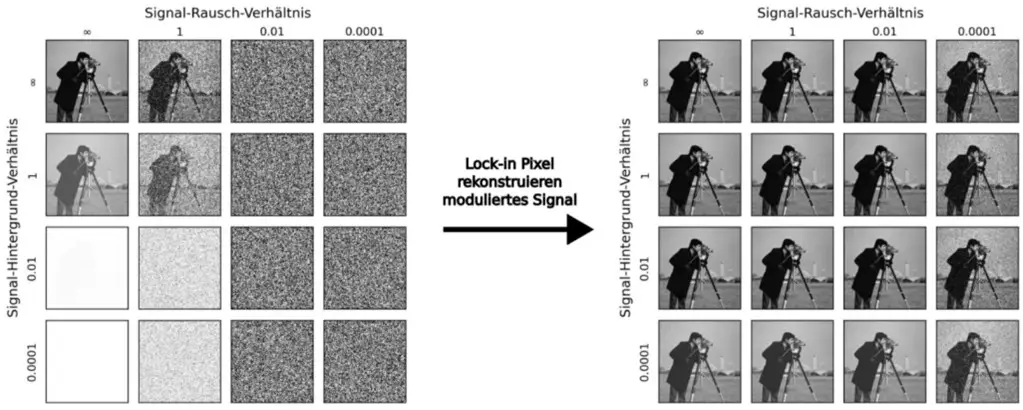
In applications with challenging lighting conditions – be it a weak signal in strong noise or very strong background or interference light – conventional cameras reach their limits. Either saturation (clipping) occurs early, or the weak signal must be averaged for noise reduction, which slows down the process or even makes it impossible. In both cases, the useful signal is dominated by interference sources. However, if the useful signal can be modulated and thus separated from the interference signals, the heliCam™ C4 continues to deliver high-quality images.

Figure 1: A camera with pixel-level lock-in technology can almost completely suppress specific interference sources such as constant background or 1/f noise.

Making weak signals visible – even in strong noise

The Lock-in Principle

A lock-in amplifier makes extremely weak signals visible, even when they are superimposed by noise and ambient light. It synchronously compares the input signal s(t) with a reference signal of the same frequency and phase (phase-sensitive detection).

Brief operation:
1. Input: s(t) contains useful signal + noise + interference signals
2. Synchronous Multiplication: with references cos(ωt) and sin(ωt) → two channels I (In-Phase) and Q (Quadrature).
3. Integration / Low-pass: Averaging over the measurement time T reduces the noise bandwidth (ENBW ≈ 1/(2T)) and suppresses components outside the reference frequency.

Result:
• Amplitude: R = √(I2 + Q2)
• Phase: φ = atan2(Q, I)
• Broadband noise and non-synchronous interference light are largely averaged out; the useful signal remains as a DC component.
• Practically, the lock-in acts like a very narrow-band, phase-sensitive filter, whose selectivity is determined by the integration time T.

In lock-in imaging, the same process is performed pixel-parallel: Each pixel provides I/Q (or amplitude/phase) – the basis for spatially resolved, phase-sensitive measurements under challenging lighting conditions.

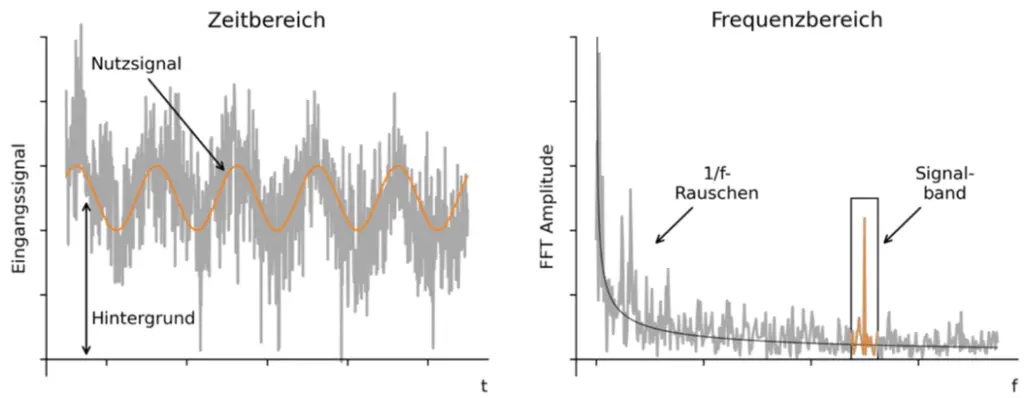
Figure 2: Heavily noisy useful signal in the time domain (left) and frequency domain (right). Despite larger interference amplitudes, the useful signal can be successfully extracted and measured thanks to the lock-in principle.

Signal Processing Directly on the Image Plane

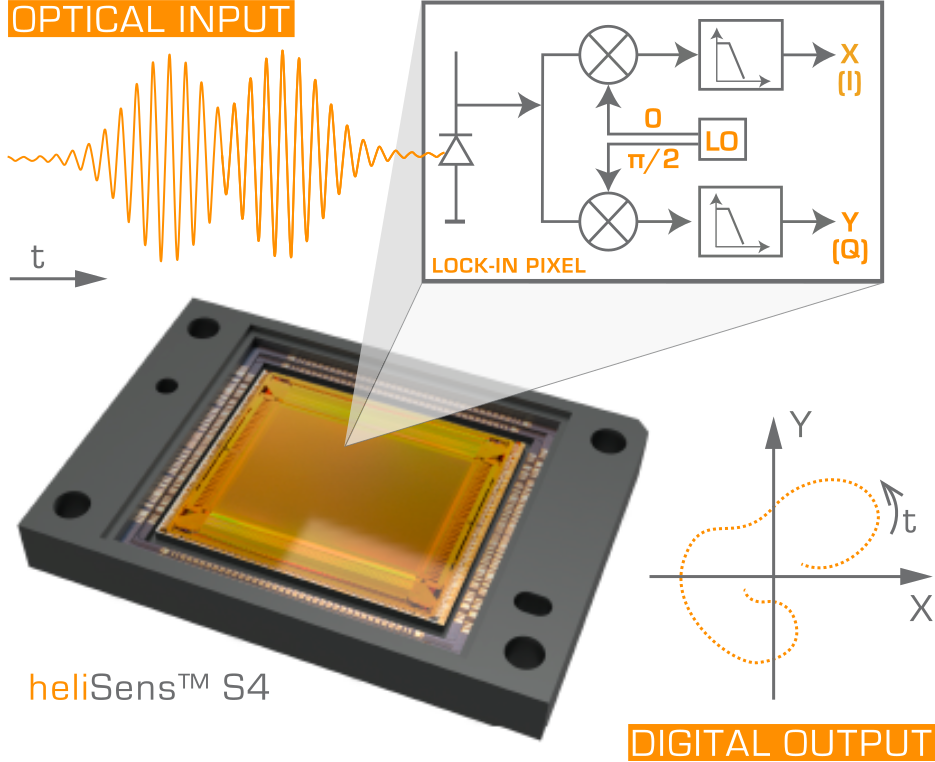
The Lock-in-Pixel signal processing, developed and patented by Heliotis, is at the heart of all our products. In our proprietary CMOS image sensor, phase-sensitive demodulation is performed directly at each pixel, rather than in the downstream signal path. Each pixel performs a synchronous I/Q measurement and outputs a 10-bit In-Phase (I) and a 10-bit Quadrature (Q) value (dual-phase demodulation). Amplitude and phase of the useful signal can be determined directly from I and Q – area-based, stable, and reproducible.

This pixel-parallel demodulation suppresses constant background, 1/f noise, and non-synchronous interference light already during acquisition, so that even very small, modulated signals become reliably visible – without long averaging times.

heliSensS4IQ3
The platform is available in two resolutions: heliCam™ C4 (512 × 542 pixels) and the high-resolution heliCam™ C4M (1024 × 1102 pixels). Thus, the C4 platform opens the way to massively parallel lock-in imaging – the technological foundation of our camera family.

Typical Applications

The application areas where lock-in cameras are most frequently used can be broadly outlined as follows:

Imaging in scattering media

A large part of research aims to capture optical images in turbid structures or, more generally, to focus light that interacts with a scattering medium.

Interferometric 3D Imaging

In interferometric 3D imaging, both improvements to scanning white light interferometry and alternative measurement methods have been proposed.

Quantitative Phase Imaging Methods

Several research groups have proposed quantitative phase imaging methods to obtain label-free and high-contrast images of, for example, biological cells, which appear largely transparent in classical, absorption-based optical measurements.

Quantum Sensing

Applications in quantum sensing are gaining increasing importance, particularly with regard to a widefield quantum diamond microscope for dynamic imaging of the smallest magnetic fields.

Spectroscopy

Spectroscopic methods that detect minute and rapid periodic changes in the spectrum, caused by various mechanisms, have been repeatedly realized with Heliotis lock-in cameras.

Further Applications

More information on the mentioned and other application examples of the lock-in camera can be found in our collection of research publications.

FAQs

Lock-in cameras are a relatively new, but extremely powerful tool in research. They open up exciting possibilities for phase-sensitive imaging and high-precision experiments.

Below you will find answers to some frequently asked questions.

The heliCam™ is ideal for experiments with strong background noise or DC components. It effectively suppresses the background and narrowly filters out the modulated useful signal – even if the signal is orders of magnitude smaller than the background. It is not optimal under extremely low-light conditions, as it has a high Full-Well Capacity (FWC) and therefore requires more light for optimal results.

The heliCam™ C4 with 542×512 lock-in pixels demodulates signals in the range of 305 Hz to 134 kHz.

The heliCam™ C4M with 1024×1102 lock-in pixels demodulates signals in the range of 305 Hz to 50 kHz.

Yes, the heliCam™ is supplied with the heliViewer™ application software – for camera configuration as well as for data acquisition, display, and export.
Yes, an SDK is available for both Python and MATLAB® – including programming examples for both languages. Additionally, other programming languages such as C++, C#, and Rust are also supported.

Further information can be found in our documentation and on the following pages:

Yes, Heliotis ships worldwide. In some countries, the heliCam™ is also available through distribution partners.
The price of the heliCam™ ranges, depending on configuration, between 15,000 and 20,000 USD.

Yes, your questions are usually answered by our support team (for installation, technical questions, etc.) and our application experts (for application-related questions) in Switzerland. Before purchase, we would be happy to provide individual and non-binding advice.

Rentals are possible after applicability has been validated with our experts.

Your direct line to Heliotis

Do you have any further questions?

Our experts will help you develop the right setup for your specific question, choose optimal parameters, and quickly lead your experiment to success.