
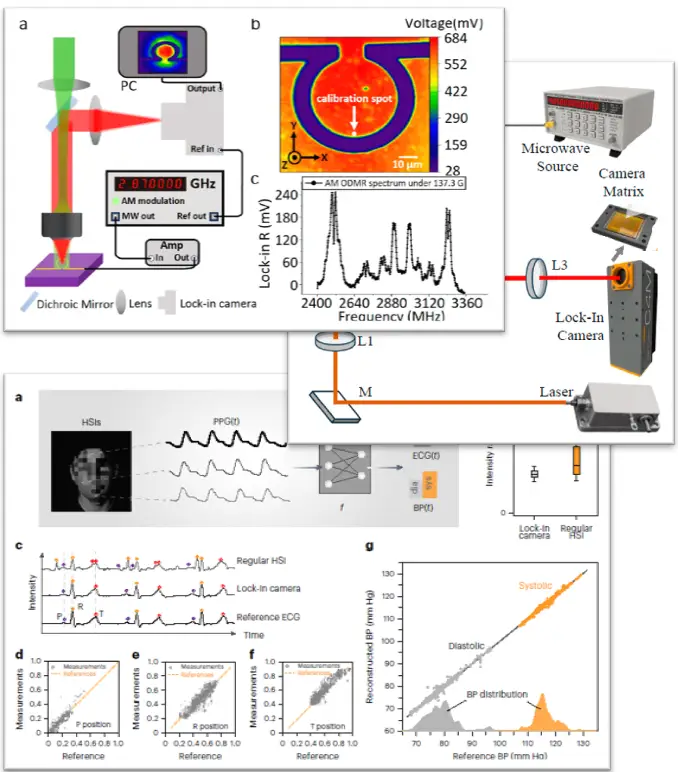
The heliCam is used by research groups worldwide to visualize extremely small signal changes, even under demanding conditions. Three recent publications demonstrate how lock-in imaging enables new pathways in biometrics, quantum sensing, and field/signal imaging.
Robust hyperspectral measurement despite ambient light: Remote biometrics (PPG, SpO₂, BP/ECG reconstruction)
A team from the University of Wisconsin–Madison presents a lock-in camera-based hyperspectral framework that modulates wavelength-specific illumination and synchronizes detection. This significantly suppresses ambient light fluctuations – a key weakness of traditional hyperspectral systems. In the validation for photoplethysmography (rPPG), heart rates are estimated with 3 bpm error; additionally, SpO₂ dynamics are extracted with 3% maximum error using dual-wavelength illumination (660/940 nm). From these high-quality signals, the authors even reconstruct blood pressure and ECG features via ML.
Diamond sensing: Detuning-insensitive wide-field imaging of vector microwave fields
Researchers at the Institute of Physics, Chinese Academy of Sciences present a method for rapid imaging of microwave fields using NV centers in diamond that is robust against detuning (e.g., due to temperature/magnetic field fluctuations). Instead of Rabi oscillations, they utilize power broadening (line broadening) in ODMR and detect differential changes via the lock-in principle (amplitude modulation + demodulation). Wide-field imaging of a micro-antenna array is demonstrated with ~800 nm resolution, including vector reconstruction across multiple NV axes and good linearity over a large dynamic range.
Quantum SiC Microscope: Imaging electrical signals current-induced magnetic fields
A team at the Helmholtz-Zentrum Dresden-Rossendorf and the Technische Universität Dresden demonstrates for the first time a Quantum Silicon Carbide Microscope (QSiCM) based on silicon vacancies in 4H-SiC. The platform utilizes lock-in detection to spatially resolve magnetic fields from electrical currents. Reported features include 50 ms time resolution, ~30 µm spatial resolution, and a sensitivity of ~2 µT Hz⁻¹ per pixel. Additionally, the authors show a dual-frequency measurement strategy for improved robustness against temperature/strain influences, as well as a simplified microwave-free imaging mode via spin-level anticrossing.
Discover more
These three publications exemplify how lock-in imaging with the heliCam makes diverse signal sources in research (biomedical optics, quantum/diamond and SiC sensing, field and signal imaging) accessible in a robust, wide-field manner with high ambient light suppression – thus enabling new measurement concepts in innovative sensor technology.
Further publications related to the heliCam (continuously updated): heliCam_papers
More about research applications with lock-in imaging: forschung_C4
 Heliotis AG