
Today, the heliCam™ is used in a wide range of scientific disciplines – from quantum sensing and magnetic field microscopy to photothermal microscopy. Three recent research papers impressively demonstrate how modern Lock-in imaging goes far beyond pure signal detection.
Although the applications appear very different, all three papers pursue the same goal: to extract additional information from extremely weak signals that would be difficult or impossible to access using conventional measurement methods.
Quantum sensing: More coherence does not automatically mean more sensitivity
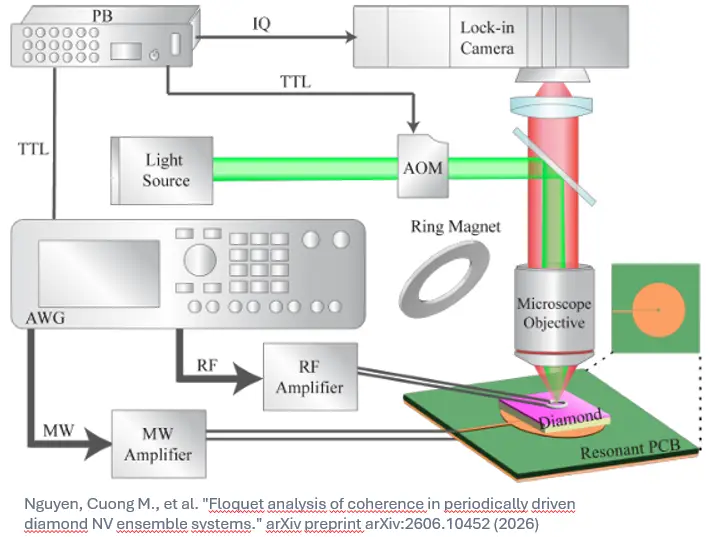
In the paper “Floquet analysis of coherence in periodically driven diamond NV ensemble systems“, the authors investigate diamond-based quantum sensors based on NV centers.
Using special excitation sequences, it is possible to significantly extend the observed coherence time of the spins. However, the study shows that a longer coherence time does not necessarily lead to higher magnetic field sensitivity. The underlying physical relationships can be explained by means of a Floquet analysis.
The work provides important insights for the development of future quantum sensors and illustrates that the interpretation of measurement data can be just as important as the measurement itself.
Magnetic field microscopy: From magnetic fields to three-dimensional current distributions
The paper “Dictionary-based reconstruction of spatio-temporal 3D magnetic field images from a quantum diamond microscope” uses imaging magnetic field measurements from a quantum diamond microscope to reconstruct three-dimensional current distributions.
Instead of merely visualizing magnetic fields, the authors combine the measured data with physical models and prior knowledge of possible current paths. This allows hidden structures to be reconstructed that are not directly recognizable in the raw data.
The approach opens up new possibilities for the analysis of complex electronic systems, power electronics, or future integrated circuits.
Photothermal microscopy: Additional information from spatial signal patterns
The paper “Photothermal microscopy beyond intensity detection: exploiting spatial signal distributions for enhanced sensitivity” pursues a similar idea from a different perspective.
Instead of looking exclusively at signal intensity, the authors analyze the complete spatial distribution of the measured signal. This allows additional information to be utilized that is usually lost in classic evaluation methods.
The result is a significantly higher sensitivity in the detection of weak photothermal signals. The work impressively demonstrates the potential inherent in the evaluation of complete image information.
A common trend: From measurement to information
The three papers come from different research areas, yet they show the same overarching trend.
Today, scientific progress is increasingly driven not by better sensors alone, but by the combination of high-resolution measurement data acquisition and intelligent data evaluation.
Lock-in imaging technologies enable the parallel acquisition of weak signals across over a million pixels. The actual innovation then often arises through new methods for interpreting this data – whether for optimizing quantum sensors, reconstructing hidden structures, or extracting additional information from spatial signal patterns.
For us, it is particularly exciting to observe how many of these initially purely scientific approaches later find their way into industrial applications. Numerous technologies used today in the semiconductor industry, medical technology, or industrial quality assurance have their origins in exactly such research projects.
You can find these and other exciting papers on the Publications on the Lock-in camera page.
We look forward to accompanying the next developments of our research partners.
 Heliotis AG